Doing a Tarot Reading on Yourself (Even as a Beginner)

Learning to do a Tarot reading on yourself really isn’t that complicated. There are a couple of rules and pitfalls to watch out for, but I would say at least 80% of the experienced readers in the community use the cards for their own questions.

A Tarot reading on yourself can be particularly useful during times of personal uncertainty or when facing important life decisions. This type of spread can provide insights into your subconscious thoughts, hidden motivations, and potential outcomes of different choices you’re considering. It’s especially helpful when you need to gain clarity on your own feelings or desires without the influence of others’ opinions, allowing for deep self-reflection and personal growth.
Problems Doing a Reading for Yourself

There’s absolutely no rule that says you can’t do a reading for yourself, but you just need to learn to watch out for:

  • Letting bias slip in. Especially if you immediately dismiss this as not even an option. We’re human. It happens. It happens often in emotionally charged topics. This is the main reason some readers won’t do a spread for themselves and would rather do it for another.

  • Overpulling spreads, hoping to get the answer you want (consciously or otherwise).

  • Be clear on the question before you pull the cards. Some beginners have a vague idea, pull some cards and then pose the question or topic in a way that the answer suits them. They often do this without meaning to or even knowing they’re doing it.

The second problem is easy. Set yourself a limit of once a day at most.

The first problem is harder. It takes time, practice and a lot of mindfulness to be unbiased about what you see in the cards.

I’ll show an example spread you could do for yourself, which can give you a bit of guidance and make it easy, but you can also use a specific spread (like this one) and just try and be wary of these things. Otherwise, you would read the cards the same as you would for any other querent.

The Spread
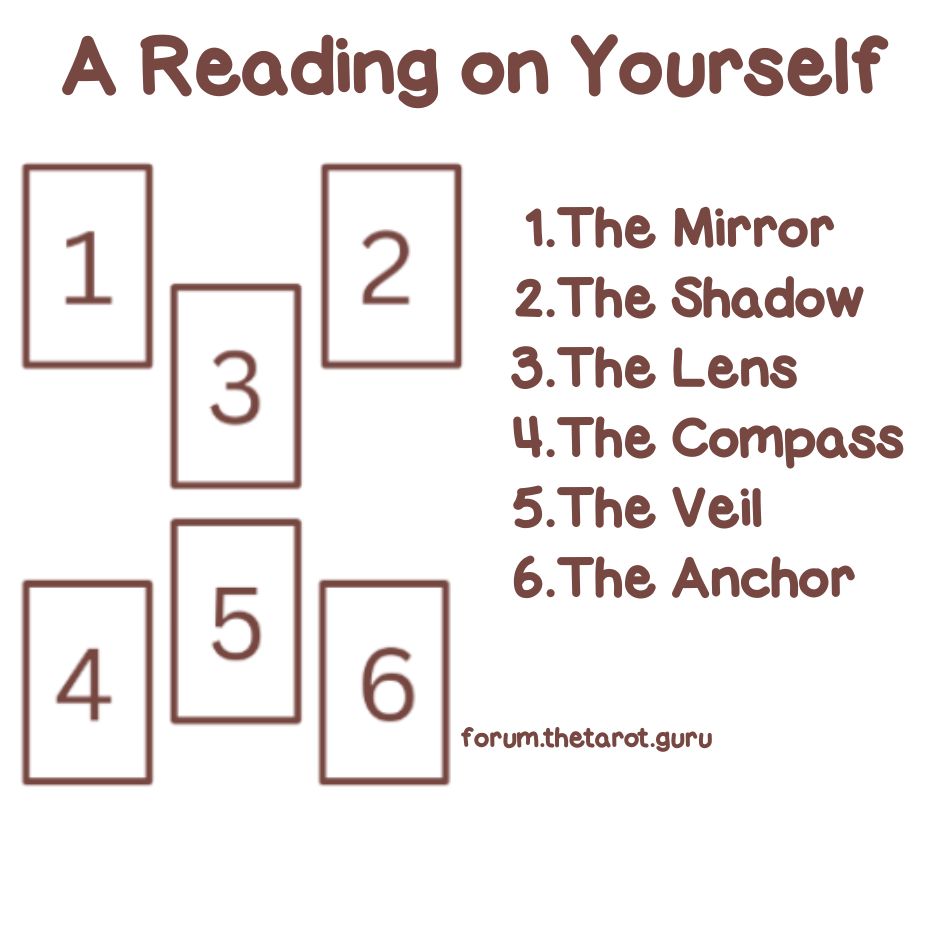
  1. The Mirror Your current self-perception and energy.
  2. The Shadow Hidden influences or blind spots affecting your reading.
  3. The Lens How you’re interpreting your current situation.
  4. The Compass Direction or guidance for your self-reading process.
  5. The Veil What you might be overlooking or need to pay more attention to.
  6. The Anchor A grounding force or stabilizing element in your self-reading practice.
  7. The Beacon Illuminating insight or revelation to focus on during your reading.

Timing & Preparation

The best time to do a Tarot reading on yourself is during a new moon, which symbolizes new beginnings and fresh insights, or when you’re facing an important decision or life switch. Before starting your reading, take a few minutes to center yourself through deep breathing or a brief meditation, which helps clear your mind and connect with your intuition. Keep your Tarot deck in a special cloth or box when not in use, and cleanse it with sage smoke or moonlight before important readings to maintain its energy.

For self-readings, the classic Rider-Waite, Smith Tarot deck is an excellent choice due to its rich symbolism and widely available resources for interpretation, while the Morgan-Greer Tarot offers similar imagery with a more modern, active aesthetic that can be particularly engaging for personal reflection. A lesser-known option that works well for self-readings is the Wild Unknown Tarot, which features minimalist, nature-inspired designs that encourage intuitive interpretation and deep personal connection.

Of course, any deck that hits home with you can be used for self-readings, as the most important factor is your comfort and connection with the cards.

When doing a Tarot reading for yourself, pay close attention to how cards interact and create a narrative together, rather than focusing too much on individual meanings. Look for recurring symbols, numbers, or elements across the spread, as these often point to important themes or energies at play in your life right now. After your reading, take time to journal about your insights, noting any initial reactions, emotions, or intuitive hits you experienced during the process (these can be just as valuable as the traditional card meanings. If you choose to read reversals, consider them as internal or blocked energies rather than negative omens, and ask yourself how you might be resisting or not fully expressing the card’s energy in your life.

Please share your experience with this reading or your variations :heart:

16 Likes

Most readings leave you with more questions than answers.

Get unlimited tarot readings and actually ask the follow-up. Full spreads, not generic meanings or automated generators.

→ Get Your Unlimited Readings Here ←

In the lands of Eastern Europe, where ancient wisdom flows through the generations, people use the Tarot for themselves all the time. Here, the cards speak not of mere futures to be predicted but of the eternal narratives that dwell within the human soul. Those who read for themselves in these traditions shall discover they are not fortune-tellers but weavers of personal legend, architects of their own mythologies.

It’s seen as a way of empowerment.

It’s really important to work on emotional intelligence alongside your tarot practice; recognizing and naming your emotions can help you stay objective when interpreting your cards, especially as a beginner.

This is good practice for anyone, but especially if you want to do personal readings for yourself.

For instance, when The Empress appears, you might notice heart chakra activation, while The High Priestess often makes sense with the third eye chakra. By understanding these chakra connections and monitoring your own energetic responses, you can distinguish between personal emotional reactions and the cards’ true messages, allowing for clearer, more balanced readings.

After tracking my own readings for a while, 87% of tarot readers who insist you can’t read for yourself also happen to have ‘Book Your Reading Now!’ buttons that flash more aggressively than a disco ball at Studio 54 - which really made me wonder if those old warnings were less about spiritual danger and more about protecting their client base!

Sooooo, have you everr thought about setting an intention before each reading? It’s like giving your cards a little roadmap to follow!

Oh yes, because nothing says ‘objective self-reflection’ quite like pulling The Tower for the fifth time and deciding it must mean ‘gentle transformation’ instead of the obvious life implosion staring you in the face.

Reading my spreads into a voice recorder first, before looking at any guidebooks, captures those raw first impressions that are usually spot-on. It’s almost comical how my recorded interpretation at 2pm sounds like a completely different person than when I re-listen at 8pm, which honestly taught me more about reading bias than any workshop ever could.

Before diving into a self-reading, have you taken a moment to cleanse your deck? This ensures a clear and unbiased energy flow.

I put off doing them for myself for years because of all the warnings… I think with some mindfulness practice it’s okay though. In some ways it maybe lets you go deeper with yourself than others could for you.

during Mercury retrograde, my readings for others flow with crystal clarity while my self-readings get tangled in those classic retrograde miscommunications, which is why I’ve switched to pulling just one daily card for personal guidance when the cosmic messenger goes backwards.

when I pull cards first thing in the morning, right as I’m still a bit drowsy, the readings feel so much clearer - it’s like that liminal state between sleep and waking creates a perfect channel for the cards to speak without my ego getting in the way.

This morning practice has become as normal to me as my first coffee, especially as I explore the Kabbalistic paths where that pure, unfiltered connection feels vital. The difference between my morning pulls and evening ones is honestly night and day - by evening, all my worries and wants have built up and I can barely see past them to what the cards are actually saying.

One thing to gently Maybe about reading for yourself is that it might lead to a bit of self-isolation. I think what can happen is that when we rely too heavily on our own self-readings, we might unintentionally close ourselves off from the valuable insights and perspectives that friends or mentors could offer us.

This is what I used when I got started.

I’ve been really reflecting on how important it is to create healthy boundaries with yourself when self-reading - literally scheduling ‘client time’ with your inner seeker and showing up for yourself the same way you would for anyone else, which has completely transformed my relationship with my deck.

There’s this practice I’ve been exploring about treating your self-readings as sacred appointments where you hold space for all parts of yourself to speak through the cards, rather than just the parts that want immediate answers.

Something cool happens when you read for your past self or inner child using old photos as a focal point, the emotional distance creates this beautiful clarity/objectivity/wisdom that bypasses all the usual self-deception. I’ve been placing childhood photos beneath my spreads and asking what guidance I’d give that version of me, then realizing the message applies to my current self too.

The technique works especially well with court cards that might represent different aspects/ages/versions of who you’ve been.

Recording yourself reading the cards out loud creates such magical accountability. Your voice captures truths your mind tries to edit away later.

When I add up all the numbers in my three-card spreads and pull a Major Arcana card based on that total, it often reveals the hidden theme that ties everything together - like when I pulled 3+7+9=19 (The Sun) during a confusing career reading, and suddenly realized the entire message was about stepping into my own light rather than hiding my talents.

Ever tried using a dedicated journal just for self-reading? For tracking patterns?