Life is complicated and messy. It’s not hard to feel stuck, like you’re behind or not be sure what you could (or should) be doing.
That’s why I created this Tarot spread for guidance. It won’t always tell you what you want to hear, but it’ll do a good job at telling you what you need. It works for the tangled situations where a daily three-card feels too thin, but a full life audit is overkill. Seven cards, readable in one sitting.
The Spread Layout
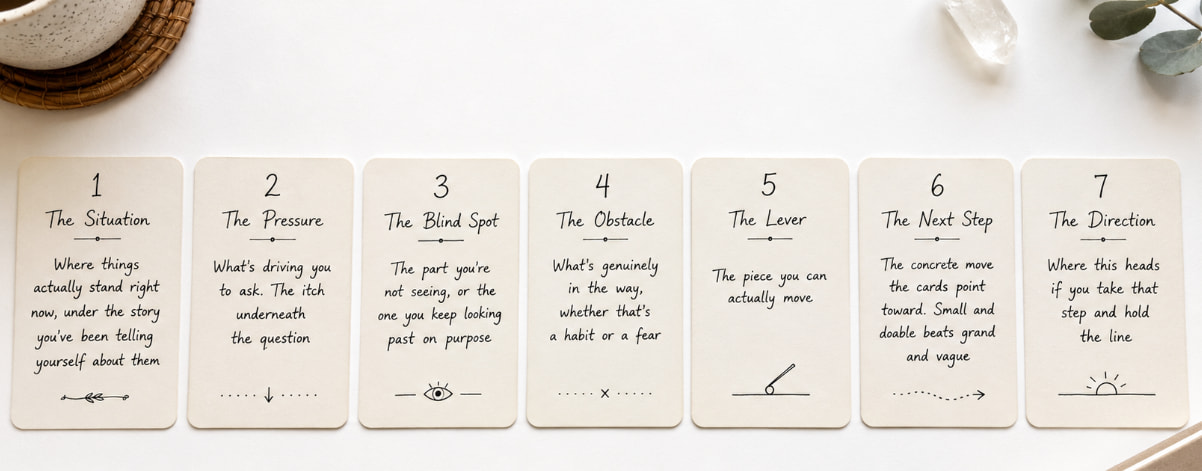
Lay them left to right in a row, or in whatever shape suits your table. The layout doesn’t really matter that much, but the position of each card does. Don’t change the meaning after you see the card, know what the position is before you pull from the deck.
- Situation: where things actually stand right now, under the story you’ve been telling yourself about them.
- Pressure: what’s driving you to ask. The itch underneath the question, which is often not the thing you’d name first.
- Blind Spot: the part you’re not seeing, or the one you keep looking past on purpose.
- Obstacle: what’s genuinely in the way, whether that’s a habit or a fear of wearing a sensible coat.
- Lever: the piece you can actually move. Guidance is useless if it points at something outside your reach, so this is the card I weigh most.
- Next Step: the concrete move the cards point toward. Small and doable beats grand and vague.
- Direction: where this goes if you take that step and hold the line.
Important Cards for Guidance
All Tarot cards can give you life guidance. Don’t fall into the trap of just looking for the major arcana, but a few of them can set the tone for the cards around them.
The Hermit is the guidance card by trade. He says the answer is already in you and the move is to slow down and listen for it. In The Next Step or The Lever, he’s usually telling you to step back before you act, not freeze in place.
The Star is direction after a rough patch. Quiet hope, a sense that you’re pointed the right way even while the ground still feels shaky. Landing in The Direction, it’s one of the kinder cards to see here.
Seven of Cups is too many options, most of them cloudy. It flags that scattered feeling where every path looks equally shiny and none of them are real yet. When it turns up in The Blind Spot, the guidance is usually to cut the list down before you choose.
Two of Swords is the stalemate. Blindfolded, arms crossed, refusing to look. It points at a decision you’ve been avoiding, not one you can’t make. Sitting in The Obstacle, it names the standoff you’ve built with yourself.
Timing & Preparation
This one suits the waning moon, when you’re clearing space and want clarity over fresh starts, or the new moon if the guidance is about setting off somewhere new.
For a day, Wednesday carries Mercury’s energy for thinking and finding your way, which fits a guidance pull nicely.
Before you shuffle, get specific about what you’re actually asking. “What should I do about my job” gives you fog. “What’s the next move with the promotion conversation” gives you something to work with. A plain white candle helps me settle, though the spread runs fine without one. Take a few slow breaths and put down the answer you’re secretly hoping for, since it’ll color everything if you let it ride along.
Reading the Cards Together
Watch the suit balance as a group.
A stack of Wands says the guidance is about action and momentum, so get moving. Lots of Cups means your feelings are steering more than you’ve admitted, worth knowing before you trust the “obvious” answer.
A pile of Swords points to overthinking, the kind that dresses up as careful planning. Pentacles ground the whole thing in practical, day-to-day reality like money or work.
Plenty of Majors means the situation is bigger than a passing mood, closer to a turning point. Court cards often stand for the actual people tangled up in it, or a role you’re being nudged to step into.
Read The Blind Spot next to The Obstacle. Together, they usually name the single thing you’ve been walking around for weeks. If the question is really a fork with two clear options, the decision-making layout narrows this same energy down to the choice itself.
Reversals here tend to mean blocked flow, a step you can’t take yet, or inner work that has to happen before the outer move. Read a reversed card as not yet, not no.
Deck Recommendations
The Rider-Waite-Smith reads cleanly for guidance because the scenes spell out action and consequence without much guesswork.
The Thoth Tarot is strong when you want the mechanics under a situation, the why beneath the what. It rewards a slower read.
If you want something earthy that keeps a guidance reading grounded instead of anxious, plenty of people around here swear by the Wildwood Tarot for exactly this sort of question. Its nature imagery pulls you toward instinct over spiraling.