Fun tip for the day time! When people ask about the “original” tarot deck, most don’t realize the cards weren’t created for divination. The earliest known tarot cards come from 15th-century Italy, where wealthy families commissioned hand-painted decks for playing card games. The Visconti-Sforza deck is one of the most famous that survived.
Tarot only became a spiritual tool much later. The Rider-Waite-Smith deck from 1909 is what most people picture when they think of tarot cards today. So there’s no single “original” deck for divination purposes, since that wasn’t even their original purpose.
I always take this stuff with a pinch of salt because… HIStory. But I do agree that there’s something pretty cool about using one of the oldest decks in history. We have a cool thread on antique Tarot decks, but if someone’s just looking for this original style without selling a kidney, the Sola Busca reprint…
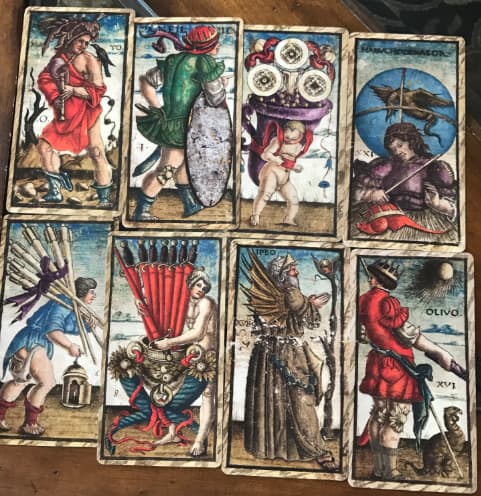
When you look at the Sola Busca deck next to the RWS, there are these unique images that don’t appear anywhere else in historical decks, like finding a connection that was hidden for centuries.
The Sola Busca uses its own system where the major arcana numbers don’t match up with what we know today, except for maybe 3 cards. This makes it pretty difficult to read with modern interpretations. The figurative minor cards are especially puzzling since they don’t align with our current meanings, though they might connect to older Etteilla interpretations that most readers don’t use anymore.
The deck vanished for 400 years and then influenced what became our most popular tarot imagery today.
The vintage deck reproductions are pretty cool. I like that they’re making these old designs accessible again instead of them just sitting in collections somewhere.
The old tarot decks have layers of meaning that people still haven’t figured out. Each card has specific imagery tied to ancient archetypes. When you look at the symbols, they seem to connect different time periods.
I wonder what the original creators were thinking and how much of this we lose with modern decks.
Visited Bologna last year and got to see Tarocchino Bolognese being played.
The locals still use this old version of tarot for their card game. They showed me how the deck was cut down to 62 cards, basically removing a bunch of the numbered cards. It was neat watching families play it in cafes. My prayer circle does readings with the full 78-card deck, so seeing this shorter version was different. Still not sure why they picked 62 specifically but that’s what stuck.
The change from aristocratic gaming to mystical practice caught my attention. ‘A Wicked Pack of Cards’ by Decker, Depaulis and Dummett has a good chapter on how tarot went from Italian courts to French occultists.
The thing is how Antoine Court de Gbelin just invented the whole Egyptian origin story in 1781. These were just Italian playing cards before that. There’s a video showing how tarocchi was actually played - the trump cards were for winning tricks in card games.
Pretty different from using Death and Devil cards for readings today.
So I’ve been looking into where the word ‘tarot’ comes from. Most people say it’s from the Italian ‘tarocchi’, but there’s another theory about it coming from the Arabic word ‘turuq’ (means ‘ways’).
What really got me thinking is how the Mamluk cards from Egypt might have influenced Italian card designs. That would mean the Egyptian versions came centuries before what we call the original.
When I checked out those early Italian decks, I saw they had 56 suited cards plus the fool and trumps. They used them for trick-taking games, which made them much more than simple fortune-telling cards.
Northern Italian cities like Milan and Venice had these elaborate card games going by the 1440s. Tarot’s gaming history goes back further than the 15th century dates you usually hear about.
Historical decks can be really hard to work with when you’re learning tarot.
No scenes on the pip cards means you’re basically just looking at a bunch of swords or cups. For people who are visual learners, these decks are frustrating. You end up having to memorize meanings instead of letting the imagery guide you. I’ve seen beginners give up because they picked the wrong deck to start with.
The owner, Menegazzi, has been painting reproductions of ancient decks by hand for decades. The Tarot was originally a decorative art form, not the mystical practice it is today.
They still make classical reproductions there, but also quirky stuff like cat-themed decks. The smoker’s tarot was particularly weird, each card shows someone with a cigarette or pipe.
When you hold those old Italian deck reproductions, you can feel how the structure makes sense.
The 22 trump cards, plus the four suits with their four court cards each had a clear logic to them. I don’t really follow traditional meanings, but that original pattern of king, queen, knight and page in each suit creates this natural hierarchy. You just get it when you see it.
The 15th century Italians probably just wanted to make a fancy card game, but they ended up creating a framework that works well for personal interpretation.
This thread shows how helpful it can be when people share different takes on the cards.
Reading through everyone’s interpretations gives me new angles I hadn’t considered before. The variety of perspectives here is what keeps me coming back to these forums.
Yeah, tarot went from being a game to this whole divination thing. Kind of shows how people want to find deeper meanings in stuff, even in a deck of cards.
As a vintage board game collector, I’ve been curious about where card games originated.
Many assume tarot was purely Italian, but that’s not quite right. Divergent thinking and all. The early playing cards from Egypt’s Mamluk period likely influenced what showed up in Italian decks (the suits, the structure, all that. Just one of those interesting historical connections you find when researching old games.
I love how historical Italian decks such as the Ancient Italian or Soprafino reproductions function. When you use them, they read similarly to the later Marseille tradition, even though they came before it.
The pip reading methods seem to carry over perfectly. This suggests that the main structure of tarot remained consistent as it moved from Italy to France. The Marseille decks preserved those original Italian designs, just with French titles instead.
So, when we read ‘Marseille-style,’ we’re actually using those older Italian roots you talked about.
So Antoine Court de Gbelin sees these Italian cards in 1781 and goes ‘these must be ancient Egyptian wisdom!’ And that’s basically how tarot got its mystical reputation.
I decided to try an original Italian deck for a reading, expecting it to be as smooth as using my usual Rider-Waite, Smith cards.
The minimalist pip cards really threw me off. Without the detailed symbols I’m accustomed to, I found myself reaching for the intuitive connections that I usually find when the cards speak through rich imagery. It was definitely an eye-opener.
The oldest tarot deck is the Visconti-Sforza from 15th century Italy. It’s interesting that it has lasted all this time.
As for the Rider Waite deck, while the Major Arcana took elements from older decks, Waite introduced plenty of new symbolism.
For example, the Lovers card in the Marseilles deck looks quite different from the one in Rider Waite. The Minor Arcana were mostly new. Arthur Waite is said to have instructed Pamela Colman-Smith on what to paint, but she likely added her own ideas. She and Waite were both in the Golden Dawn, so she was definitely knowledgeable.
If you’re interested in chatting more about tarot history, feel free to reach out.