An Easy Beginner Tarot Spread

If you’ve just picked up your tarot for the first time and you have your cards and a book explaining the indiviual meanings… what do you actually do next?

I thought we’d put together a quick and easy beginner Tarot spread. This layout keeps it simple while giving you insights and guidance without extra complications.

This simple spread typically uses 3-5 cards (from whatever deck you have) and can be helpful when you need clarity on a decision, want to understand the energies surrounding a current issue, or are looking for general guidance for the day ahead. It provides a snapshot of the present circumstances, potential challenges, and possible outcomes, making it a practical tool for everyday problem-solving and self-reflection.

The Spread
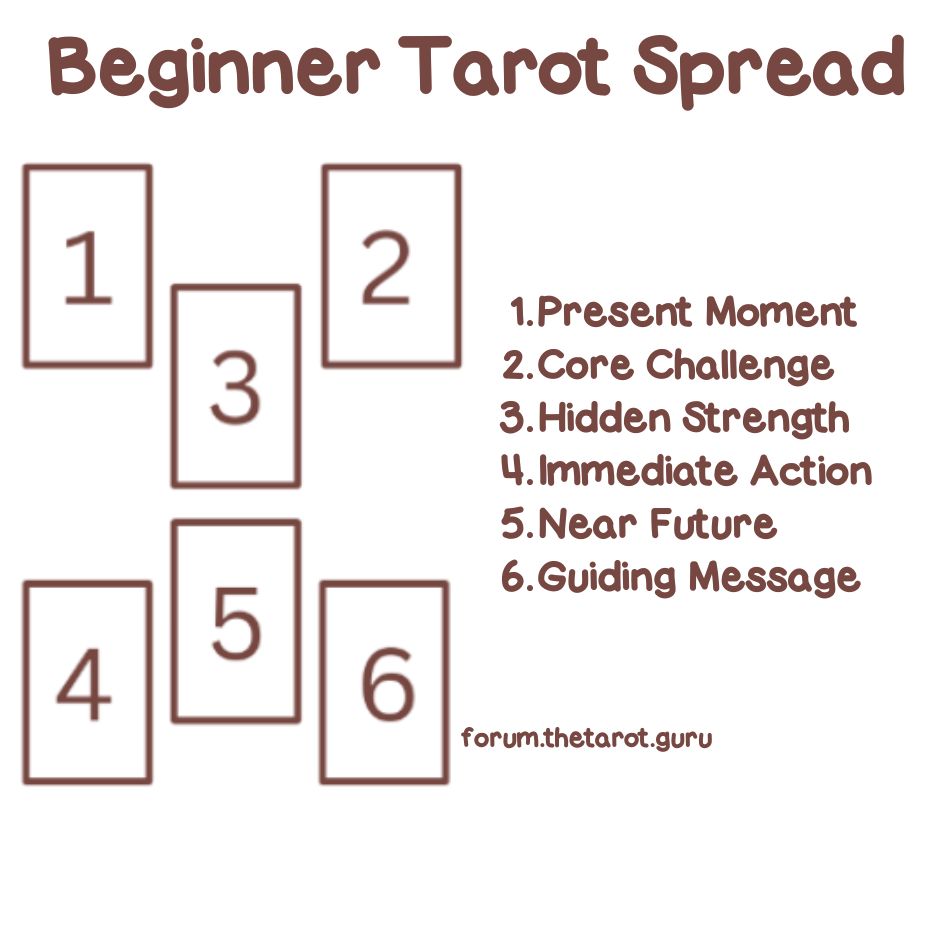
  1. Present Moment Your current situation and energy.
  2. Core Challenge The main obstacle or issue you’re facing.
  3. Hidden Strength - An asset or ability you possess but may not be fully aware of.
  4. Immediate Action - A step you can take right now to improve your situation.
  5. Near Future - The likely outcome if you continue on your current path.
  6. Guiding Message - Advice or wisdom from the universe to help you move forward

Significant Cards

As a beginner, every card is important, but it’s not about the individual card, but about the combined meaning of the cards. This should be the first thing you focus on.

The Fool often appears as a powerful indicator of new beginnings and fresh perspectives, encouraging the querent to embrace opportunities with an open mind. The Six of Cups, in this context, frequently suggests nostalgia or reconnecting with one’s inner child, offering insights into how past experiences shape current situations. Watch for the Wheel of Fortune, which typically signifies a turning point or change in circumstances, reminding the reader that life is cyclical and fortunes can shift unexpectedly.
Timing & Preparation

Try performing this spread during the waxing moon phase, which symbolizes growth and new beginnings. Before starting, take a few deep breaths and light a candle to create a calm, focused atmosphere, helping you connect more deeply with your intuition and the cards.

The classic Rider-Waite, Smith deck is an excellent choice due to its clear imagery and wealth of available resources, while the Modern Witch Tarot offers a fresh, inclusive take on these familiar symbols that many newcomers find appealing. For a lesser-known option, the Everyday Tarot mini deck by Brigit Esselmont provides simplified illustrations that capture the meaning of each card, making it particularly suitable for beginners who might feel overwhelmed by more complex imagery. Of course, readers can use any deck they feel drawn to, as the most important aspect is developing a personal connection with the cards.

Pay close attention to how the cards interact and tell a story together, rather than just interpreting them individually. Look for recurring symbols, numbers, or elements across the cards, as these often point to important themes or energies at play in the reading. After each session, take a few minutes to journal your insights, noting any intuitive hits or personal connections you made - this will help deepen your understanding over time. If you choose to read reversals, think about them as internal or blocked energies related to the card’s upright meaning rather than as complete opposites, which can provide a more complex perspective for beginners.

Please share your experience with this reading or your variations :heart:

19 Likes

Most readings leave you with more questions than answers.

Get unlimited tarot readings and actually ask the follow-up. Full spreads, not generic meanings or automated generators.

→ Get Your Unlimited Readings Here ←

three-card spreads are amazingly flexible, you can use the same layout for decision-making (Option A, Option B, Balance Between), problem-solving (Situation, Challenge, Advice), or even just daily guidance (Present, Future, Advice), and the cards will speak differently based on what you’re asking! It’s like having one magical tool that transforms to meet whatever you need in the moment, you got this, and your intuition will guide you to the right interpretation every time.

Okay, so here’s something I learned after buying my 47th tarot deck (yes, I counted): stop reading cards like they’re in solitary confinement!

The biggest thing beginners should focus on. Biggest trap they fall into and never get out.

I used to look at each card individually and totally miss how they’re basically having a whole conversation with each other. Trust me, after spending way too much money on decks that ‘spoke to me’ at 2 AM, I’ve realized you gotta see how the cards vibe together. The whole spread is like a group chat. You can’t just read one message and think you know what’s going on. This obsession has at least taught me that looking at the big picture saves you from those embarrassing ‘oops, totally misread that’ moments.

One thing I’ve noticed is that new readers often think mastering tarot means memorizing all 78 card meanings perfectly, when actually the real growth happens when you start actively using simple spreads like this one, it’s less about ‘knowing’ the cards and more about developing a practice with them.

Don’t overthink it or try to memorize anything. I know Tarot readers who have been doing it 10+ years who couldn’t tell you all the Biddy Tarot definitions of each card or even close.

Thank you for sharing this, if any beginners are just getting started feel free to DM any questions or just post them here :heart:

Well, actually, while those 3-5 card spreads are wonderful starting points, I’ve noticed beginners often benefit from doing single-card daily pulls for their first week or two before jumping into multi-card layouts; it helps build that critical card-to, intuition connection without the overwhelming of interpreting relationships between cards.

Once you’ve built that foundation, transitioning to a simple past-present, future spread feels much more natural, and there’s this approach that demonstrates exactly how to make that leap from single cards to reading them as a flowing narrative. Giving yourself permission to start even simpler than you think you need to because confidence with one card naturally evolves into comfort with three or five.

I’ve been doing readings at friends’ gatherings lately and discovered this amazing three-card variation that’s even simpler than the spread you shared, Mirror (current state), Medicine (what you need for healing), and Message (divine guidance).

My normal layout for quick party readings is because it cuts straight to what people need to hear without overwhelming them with too many cards. The Medicine card especially clicks with folks since it gives them something concrete to work with rather than just pointing out problems.

During the current waning crescent moon, position 5 (Near Future) tends to reveal releasing patterns rather than new developments, which actually makes SO much sense energetically

Last month during the full moon, that same position showed expansion themes in everyone’s readings at my circle. Maybe we should adjust our interpretations based on lunar phases? Like during new moons, position 1 (Present Moment) could show seeds being planted rather than current reality manifesting.

After years of working with elaborate Celtic Cross layouts (I really like your guide on that), the most profound insights often emerge from simple three-card variations whether it’s the Bridge spread, mapping your process from the current state to the desired outcome, or a daily pull exploring focus, challenge, and lesson dynamics.

The elegance lies not in complexity but in how these minimal arrangements force you to synthesize meaning between cards rather than getting lost in positional minutiae.

Hey beginners!

One thing to 100% watch out for is reading too often. It’s tempting to pull cards daily or even multiple times a day, but doing so can lead to over-dependence and muddled messages. I see a lot of beginners get excited (and that’s great) and all they want to do is pull cards but this can make things harder for you.

Try spacing out your readings to give each one the space to resonate. This is actually something we discuss a lot in my local tarot meetup group; many members have found that switching to weekly personal readings while practicing more frequently in our reading circles helps them maintain clarity. The group setting allows you to practice without overexerting yourself, and you also gain diverse perspectives from other readers.

Um, so I’ve been reading that it might take, like, months or maybe even years to get good at this? I mean, to develop a reading style that feels natural and stuff. I hope that’s normal because sometimes I worry I’m not progressing fast enough.

Someone told me it’s kind of like learning a new language, which makes sense I guess? Like, apparently you slowly start to understand what the cards are trying to tell you, but it takes time. A lot of time. Which is kind of scary but also reassuring? I don’t know, I just hope I’m doing this right.

Even with just three cards, readings can spiral into confusion when you’re starting out, I used to get so caught up in every possible meaning that I’d lose the thread completely…

Treating the cards like they’re having a conversation with each other rather than reading them as isolated messages. Now when I pull cards for love or career questions, I look for the story they’re telling together first, then dive into individual meanings. It’s made my readings so much clearer and actually fun instead of overwhelming.

The example above of the cards talking like a group chat is perfect.

I started matching specific decks to different reading types, like using my gentler oracle deck for healing work versus my no-nonsense tarot for reality checks, my readings became so much more accurate it was practically deck-adent!

When I first started with tarot, my intuition would freeze up the moment I saw the cards (even though I’d done oracle readings before!), but I found that brewing chamomile tea while shuffling for The Present Moment card and peppermint for The Immediate Action position helped calm my nerves and open up those intuitive channels, now it’s become my ritual for this exact spread!

From my experience, younger readers or those new to self-reflection might find it harder to connect deeply with the cards at first, IMO. As you gain more life experience, your readings might naturally become richer and more subtle, IMHO. Don’t rush it; let your understanding grow with you.

For me, the biggest thing beginners need to worry about is confirmation bias. We’re all human and it happens but it’s horrible for Tarot readings.

It’s easy to see what you want to see in a reading rather than what’s actually there. Even my cats seem to judge me when I’m trying too hard to make the cards fit my desired outcome. Keeping a tarot journal can help you stay objective and track your growth, plus it gives you somewhere to jot down those moments when your familiar decides to sprawl across your spread mid-reading (which obviously means something, right?).