The horseshoe spread is for a situation that is too tangled for a three-card pull, but I don’t want the full sprawl of a Celtic Cross. Seven cards laid out in a U, each one answering a plain question about where you are and what to do about it. I use it most for the messy practical stuff: a job that’s gone sideways, a move I keep putting off.
It works for almost any question that isn’t strictly about another person’s feelings. If you’re chewing on a specific choice, it pairs well with a more focused decision-making spread, but the horseshoe earns its keep when you want the whole picture before you commit to anything.
The Spread Layout
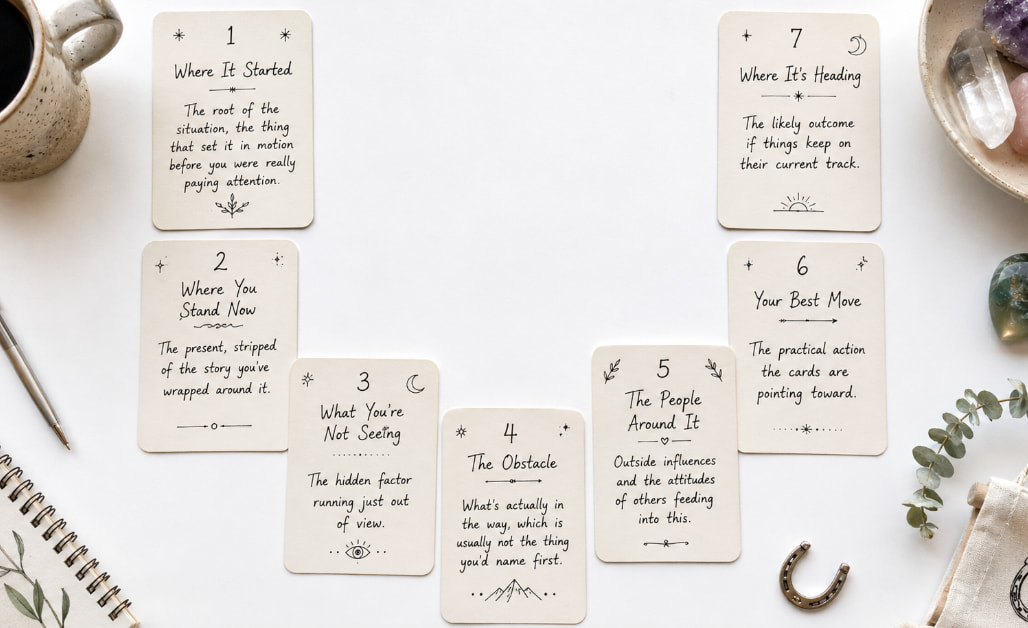
- Where It Started: The root of the situation, the thing that set it in motion before you were really paying attention.
- Where You Stand Now: The present, stripped of the story you’ve wrapped around it.
- What You’re Not Seeing: The hidden factor running just out of view.
- The Obstacle: What’s actually in the way, which is usually not the thing you’d name first.
- The People Around It: Outside influences and the attitudes of others feeding into this.
- Your Best Move: The practical action the cards are pointing toward.
- Where It’s Heading: The likely outcome if things keep on their current track.
Cards to Watch For
Every card pulls its weight here, but a few of these set the tone for the ones beside them and make the rest easier to read.
Wheel of Fortune: The situation is already moving with or without your input. In Where It’s Heading it says momentum is on your side, assuming you’ve laid the groundwork. Landing in Where You Stand Now, it’s a sign the timing is turning and the thing you’ve been waiting on is closer than it feels.
The Hanged Man: A deliberate pause, and usually the holdup is the point. If it shows in The Obstacle, you’re being asked to wait, or to look at the whole thing upside down before forcing a move that isn’t ready.
Eight of Swords: Feeling boxed in while the way out sits right there. In What You’re Not Seeing or The Obstacle, it points at a trap you’ve half-built yourself, the kind that loosens the moment you stop assuming you’re stuck.
Seven of Cups: Too many options and none of them in focus. Spot it in Your Best Move, where it warns you off chasing the shiniest choice instead of the workable one. It names the indecision so you can cut through it.
Timing & Preparation
The horseshoe doesn’t need a special moon, but I like it on a waning moon when I’m clearing something away, or on a Wednesday for Mercury’s head-clearing energy, which suits a problem you’re trying to think straight about. Light whatever candle helps you settle if you work with them.
Before you shuffle, get the question concrete. “What’s going on with my job?” is too loose to answer well. “Should I stay in this role through the year?” gives the cards something to bite on. Take a few slow breaths and be honest about the outcome you’re secretly rooting for, since naming it stops it quietly steering your read.
Reading the Cards Together
Look at The Obstacle and What You’re Not Seeing as a pair first.
Together they tend to name the one thing you’ve been working around without admitting it. Then check Your Best Move against Where It’s Heading, since the advice card exists to nudge that outcome, and any tension between the two tells you how much effort the shift will take.
Watch the suit balance too.
A stack of Swords says the problem is living in your head more than out in the world. Heavy Pentacles keep it grounded in the practical, the money and the work. Lots of Cups means feelings are driving harder than you’ve owned up to. Reversals here usually read as delays, or inner work to sort before the outer situation budges.
Deck Recommendations
Rider-Waite-Smith is my default for this one because the scenes do half the interpreting for you, which matters when you’re reading a situation rather than a mood.
The Wildwood Tarot suits the horseshoe if you want something earthier. Its imagery leans into cycles and natural processes, which fits a spread about how a situation grows and turns. There’s a decent thread on how people are getting on with it if you want other opinions first.
Thoth Tarot works well when you want the structural bones of a problem, since it’s strong on the mechanics sitting under a situation.
What do you reach for the horseshoe for? And does anyone run a different set of positions for those middle three? Mine have changed over the years, but this has been my most stable version of the spread for a while now.