Most of my spreads answer one question. This one maps the whole thing, top to bottom, the way the old Kabbalistic Tree is built. I pull it when a situation is too big or too tangled to fit into a tidy 3-card layout and I need to see how the parts feed each other. It takes a while and it asks more of you than a quick daily pull, so I save it for the questions that earn it.
The ten cards sit on the ten sephiroth, from Kether at the crown down to Malkuth at the base. You can read it top-down, cause flowing into effect, or bottom-up from where you actually stand. I usually start at the bottom and climb, since Malkuth is the part of the situation I can already feel.
I love the Tree of Life but I wouldn’t use it as a beginner Tarot spread. This one might take a bit of practice before you’ll get much from it.
The Spread Layout
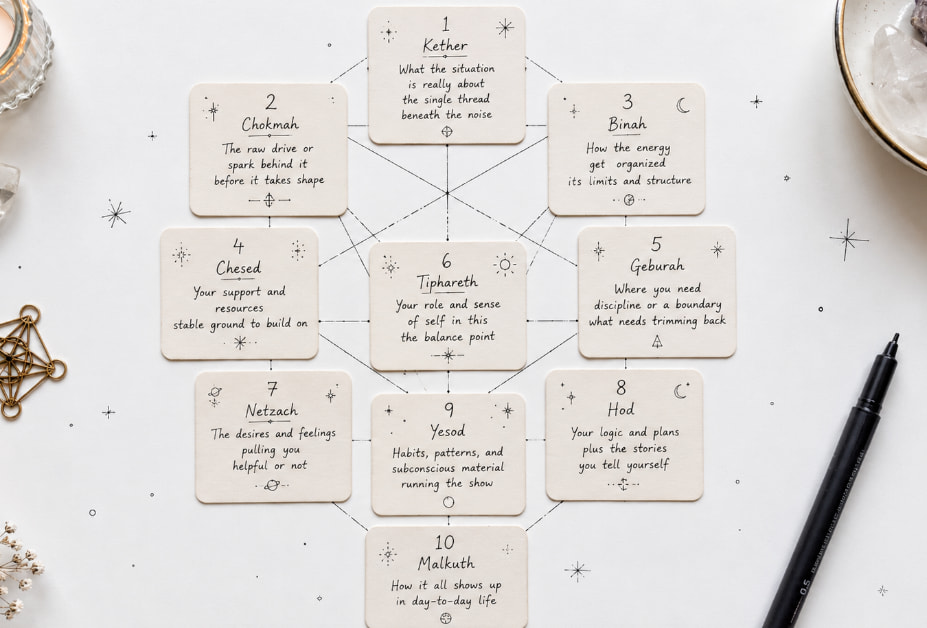
- Kether (the top line). What the situation is really about once you cut the noise. The single thread everything else hangs from.
- Chokmah (the push). The raw drive or spark behind it, before it has taken any shape.
- Binah (the shape). How that energy is getting organized, plus the limits and structures it runs into.
- Chesed (what holds you up). Your support and resources, plus the stable ground you can actually build on.
- Geburah (the cut). Where you need discipline, a boundary, or something trimmed back. Most of the friction lives here.
- Tiphareth (you, centered). Your own role and sense of self in the middle of it. The balance point of the whole spread.
- Netzach (what you want). The desires and feelings pulling you, helpful or not.
- Hod (how you’re thinking). The mental side: your logic and plans, plus the stories you keep telling yourself.
- Yesod (the engine room). The habits and patterns, plus the subconscious material quietly running the show.
- Malkuth (where it lands). How all of the above actually shows up in your day-to-day life.
If the question is “how many cards do I pull?” the Tree of Life answer is just… “yes”. It’s one of the biggest popular spreads and it can take a lot of work.
Cards Worth Watching
Every card matters in a spread this size, but a few of them will set the tone for whatever sits around them. These are the ones I clock first because they tell me which way the rest is leaning.
The World in Malkuth
About as clean a confirmation as the deck gives. The whole tree resolving into something real and finished, landing right where it counts. If you’ve been waiting to see whether the work pays off in the physical world, this is the card that says it does.
The High Priestess in Yesod
Yesod is the moonlit, subconscious floor of the tree, and the High Priestess belongs there completely. She’s telling you the foundation is intuitive, not logical, and that the read you keep half-ignoring is the accurate one. Trust the gut here instead of arguing it down.
The Sun in Tiphareth
Tiphareth is the heart of the tree, its solar center, so the Sun showing up in this exact spot is a strong alignment. Vitality and clarity at your core, no hidden agenda muddying the middle. When this lands in position six, the rest of the spread tends to read warmer.
The Tower anywhere on the pillars
Wherever it falls, something built is about to come down, so the position tells you what. The Tower in Binah or Geburah (the left, structural side) usually means an old form or rule is breaking. On the right pillar, it’s more about an overextension finally collapsing.
Either way, focus on the neighbor cards, because they show you what gets rebuilt.
How to Read the Spread Together
The real power of this layout is the three pillars, and reading by pillar will tell you more than any single card.
The right side, the Pillar of Force (Chokmah, Chesed, Netzach), is drive and expansion. It’s the giving side.
The left side, the Pillar of Form (Binah, Geburah, Hod), is structure and restriction, with analysis mixed in.
The four cards down the Middle Pillar (Kether, Tiphareth, Yesod, Malkuth) are your spine, where everything is meant to balance.
Look at which side is loud. A right-pillar pileup of strong cards usually means you’re overextended or scattered, pouring out more than you’re holding. A heavy left pillar points the other way, toward rigidity or over-control, or feeling stuck in your own rules. When the middle carries the weight, the matter is squarely about your core path, and you’re probably more integrated than you feel.
A few more things I watch for:
- Lots of Major Arcana The more Majors, the bigger and more fated the situation. Three or four of them clustered near the top (Kether, Chokmah, Binah) tells me this is a turning point, not a passing mood.
- Suit weighting. A wall of Cups means emotion is steering. Stacks of Swords flag overthinking, often around Hod. Pentacles ground the reading in money and body, along with practical reality.
- Reversals. Here they tend to mean blocked flow between spheres, energy that can’t move from one position to the next. Read the reversed card as a clog, not a hard no.
If one corner dominates and it’s the buried, uncomfortable stuff (Geburah and Hod doing a lot of talking), that’s a sign to follow up with a focused session. I’ll sometimes run a dedicated shadow work spread afterward to dig into whatever the tree only hinted at.
Timing & Preparation
This isn’t a Tuesday-morning pull. I do it at the new moon when I want a fresh full-life audit, or at a real turning point like a birthday or the start of something big. Give yourself an evening you won’t rush.
Because it’s ten cards, lay the shape out before you shuffle so you’re not scrambling mid-read. I sketch the tree on paper or set down ten face-down markers in position first. Get steady, get specific about the question, then deal Kether to Malkuth in order.
A single candle helps me settle if I’m working with one, though the spread carries itself without any props.
Deck Recommendations
The Thoth Tarot (Crowley and Harris) is the natural choice, since it was built directly on the Golden Dawn Tree of Life. The correspondences are baked into the imagery, so the cards almost slot themselves onto the sephiroth.
The Rider-Waite-Smith works perfectly well too. It shares the same Golden Dawn roots and reads more plainly, which keeps a ten-card spread from getting overwhelming.
If you want something steeped in the system itself, the Hermetic Tarot is dense with Kabbalistic and astrological detail and suits this spread beautifully. It does run intense, so check how people found the Hermetic Tarot for beginners before you commit to learning on it.