Two cards are the smallest spread that still gives you something a single pull can’t: a relationship between card meanings and reading the message in the combination of Tarot cards is how real readers actually get a message from the cards (and not just a list of keywords from a guidebook).
One of the first guides I wrote here was on doing a one-card reading, and most of that was trying to convince people to… not do a one-card reading. I think a 2-card spread is best for beginners who have one simple question to start with.
If you try to load this reading up with complex tasks and multiple questions, it won’t get you far. I have much more detailed tarot spreads for that kind of task, but this can be a good place to start. It’s an excellent place to start practicing using the card combinations in a beginner setting.
One card answers, two cards talk to each other, and that back-and-forth is where the read actually lives. I reach for this when a daily draw feels too thin, but the question doesn’t warrant laying out a ten-card tree of life.
The Spread Layout
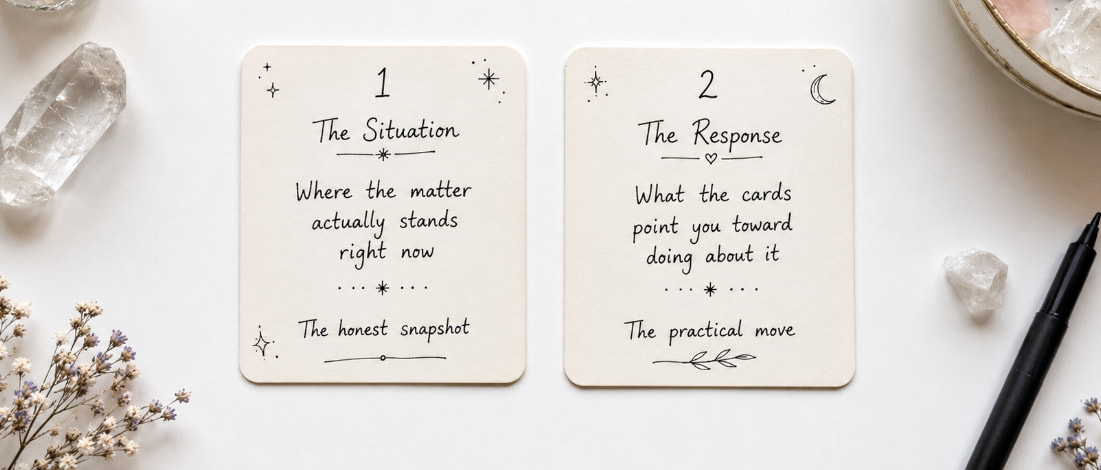
Two positions, laid left to right. There’s only really so many ways you can do a 2-card layout.
-
The Situation. Where the matter actually stands right now, stripped of the story you’ve been telling yourself about it. This card is the honest snapshot.
-
The Response. What the cards point you toward doing about it. Read it as the practical move, the attitude to take, or the thing you’ve been quietly avoiding.
That’s it.
That’s the workhorse version. The two-card frame bends to fit whatever you’re asking, so swap the labels when it suits: you and them for a relationship check, cause and effect to trace why something happened, what to keep against what to drop for a clear-out, or what I hope beside what’s likely when you need the gap between the two spelled out.
Just be sure that you’ve set the meaning of the position before you draw the card. Don’t swap it afterward.
Important Cards
With only two cards on the table, each one carries far more weight than it would in a big spread but don’t fall into the beginner trap of just looking for the major arcana.
Two of Swords
The stalling card, and it turns up in the decision, reads constantly. Blindfold on, arms crossed, refusing to look. It’s telling you the deadlock is self-made and that you already have the information you’re pretending you don’t. Sitting in The Response, it’s a nudge to take the blindfold off.
The Chariot
Forward drive and a decision already half-made. Where the Two of Swords sits frozen, the Chariot has picked a direction and wants you to commit and hold the reins. Strong in the second position, it reads as go rather than wait.
Seven of Cups
Too many options, most of them fog. This card shows a mind spinning out shiny maybes instead of choosing. If it lands in The Situation, the real problem is scatter, and the read is asking you to narrow down before you act.
Eight of Cups
The quiet exit. Someone turning their back on something that looked fine on paper because it stopped feeding them. In a two-card pull about whether to stay or go, this one leans hard toward go, with no drama attached.
Reading the Two Together
The whole point of two cards is what passes between them, so read the pair as one sentence rather than two separate answers.
Start with whether they agree or argue. Two cards pulling the same way give you a clean, confident read. Two that clash are naming the tension itself, and that friction is usually the answer.
Watch the suits. Both cards in one suit tightens the reading to a single arena: Cups for feelings, Pentacles for money and the body, Swords for the mental knots, Wands for drive and momentum. Two different suits show you two forces rubbing against each other.
A Major beside a Minor is a useful combination, since the Major names the bigger theme you’re inside while the Minor tells you how it’s playing out day to day. Two Majors in a spread this small means the question is heavier than two cards can hold, and that’s my cue to pull a few more.
Reversals here tend to read as lag or blockage between the pair, energy that hasn’t moved from the first card to the second yet. Treat a reversal as a hold-up rather than a flat no.
Timing & Preparation
The appeal of a two-card pull is that it fits any moment. I use it as a morning check before a full day or as a quick gut-check when a decision is sitting on me. There’s no need to wait for a moon phase, though a waxing moon suits it if you’re building toward a choice.
Keep the ritual light to match the spread. A slow breath or two, one clear question held in mind, then deal the first card to the left and the second to the right without reshuffling between them. The thing that matters most is a sharp question. With only two cards to work with, a vague ask like “how’s my life?” gives vague mush back, while “what am I not seeing about this job offer?” gives you something to actually hold.
Deck Recommendations
Because you’re reading fast and light, a deck whose imagery is already in your bones helps more than anything clever. The Rider-Waite-Smith earns its spot here for that reason. Its scenes are legible at a glance and you won’t be reaching for the guidebook mid-pull.
If two cards still feel like a lot to interpret cold, a deck with the meaning printed on the card can carry you until the images stick. There’s a solid rundown of decks that print keywords right on the card that suits snap reads like this one.
