After decades of reading Tarot, writing guides and posting at least 100+ tarot spread breakdowns, I think the three-card Tarot spread is probably the most commonly used.
Easy enough for beginners, yet nuanced enough for an experienced reader to combine cards and positions to get a real message. It’s quick and flexible for just about any question, giving you enough to work with without turning into an hour-long production. When someone asks for a good place to start, this is usually what I suggest, because three cards show you how the positions relate before you move on to bigger layouts.
That’s a skill you’ll use in everything that comes after.
Three cards won’t map out a whole life the way a ten-card spread does, and that’s fine. Most of the time you don’t need the whole picture. You need a clear sense of where things stand and what to do next, and this spread gives you that in about five minutes.
The Spread Layout
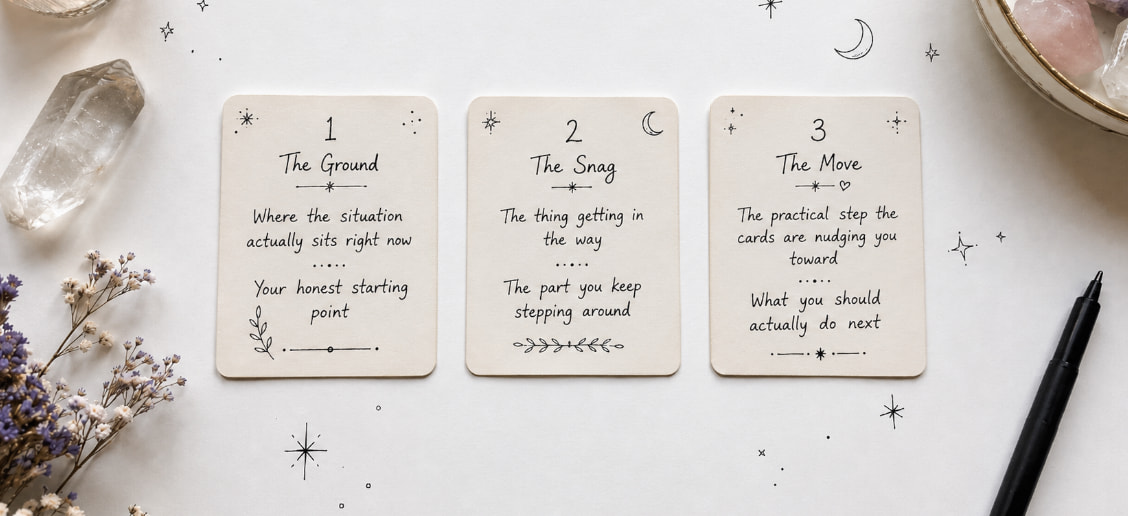
- The Ground. Where the situation actually sits right now, stripped of the spin you’ve put on it. This card is your honest starting point.
- The Snag. The thing getting in the way. Sometimes it’s an outside obstacle, more often it’s the part you keep stepping around.
- The Move. The practical step the cards are nudging you toward. It’s the thing you should actually do next.
The labels are flexible. You can swap them for past, present, or future, or slot in a fourth like want, block, need and the same three cards will answer a different question. I keep coming back to ground, snag, move because it ends with something I can act on instead of just something to think about.
Important Cards in a Three-Card Spread
Every card is important in every spread, but there are a couple I would look out for specifically in this kind of reading. In a spread this small, one loud card can tint the whole reading.
The Tower. In three cards, it takes over the reading (and I say that as someone who always warns against relying on the major cards). If it’s in The Ground, the situation is already coming apart and you’re reading the rubble. In The Move, it honestly suggests stopping propping up something that wants to fall.
Eight of Wands. This card is about speed. Events are already rolling and moving faster than you’d like. In The Move it’s a push to act while the window is still open, since it won’t stay open long.
Two of Swords. A stalled choice with the blindfold on. It’s most telling in The Snag, where it points to the decision you’ve been avoiding as the real obstacle. The issue is the call you’re not making, not something outside you.
The Hermit. A card that asks you to step back. In The Move it reads as permission to wait and think rather than force an answer today. Not every spread wants action.
Timing & Preparation
This is the everyday spread, so it doesn’t need a full moon or a particular weekday to work.
I pull it with morning coffee when I want a quick read on the day ahead. If the question carries more weight, a waning moon works well for sorting things out and a new moon is good for fresh starts, but three cards are pretty forgiving about timing.
Keep the prep light as well. A few slow breaths, a clear question, then shuffle. A candle is nice if you already work with one, though this spread stands up fine without any staging. Vague questions still hand back vague answers, so get specific before you deal. “What’s going on with this job offer and what do I do” pulls a sharper read than “tell me about my career.”
Reading the Spread Together
The middle card is the hinge. Once all three are down, read The Snag first, because it usually explains why The Ground looks the way it does and why The Move is the move.
Watch the suits as a group. A pair of Cups usually signals something emotional. Pentacles steer things toward money or practical concerns. Swords often point to overthinking or a conversation you’re dreading. Wands add drive and momentum. With only three cards on the table, even two of one suit is a strong signal worth trusting.
A Major Arcana card counts double here.
One Major among three minors is the loudest voice at the table, and it tells you the matter is bigger or more fated than a quick daily question would suggest. Two or three Majors and you’re looking at a real turning point rather than a passing mood.
Reversals in a three-card spread usually read as a stall, energy that can’t move cleanly from one card into the next. A reversed Move is closer to not yet than never, so treat it as a delay and look at what’s clogging the flow.
Deck Recommendations
Because this is the spread I hand to beginners, I keep steering them toward the workhorse decks for it.
The Rider-Waite-Smith is the obvious pick. The scenes carry enough story that three cards give you plenty to chew on, and it’s the deck most books and guides quietly assume you’re holding. If you’re still choosing a first deck, the thread on what people actually start with covers the usual contenders.
For a faster daily pull, a deck with keywords printed on the cards keeps a three-card spread moving when you don’t want to stop and look anything up. Something clean and modern reads quickly, which suits a layout you might run every morning before the kettle’s even boiled.
Credit where it’s due some spreads were shared over on this old thread as well but I thought we could use a proper write up. If anyone has any other suggestions for a three card spread I’d invite you to add them to the thread!
